早川めぐみ
Diskografie
EPs & Singles 2
Beschreibung
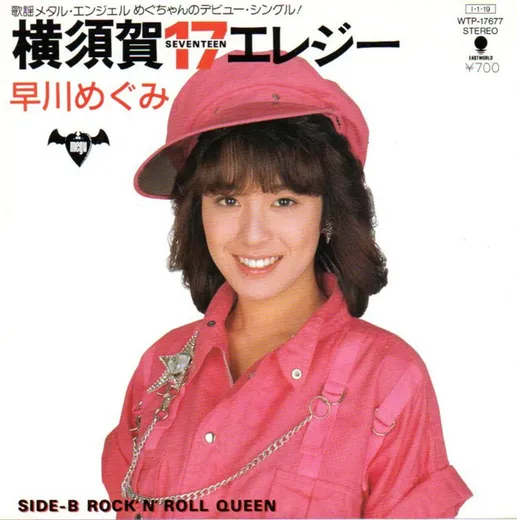
The era of the ジャパメタクィーン (Japa Meta Queen) kicked off in the early 1980's with the dual assault of Mari Hamada and Misako Honjou, but according to a few sources I read, the first Queen to land on the Oricon chart didn't occur until early 1985, when 早川 めぐみ (Hayakawa Megumi) burst onto the scene with her single "横須賀17(Seventeen)エレジー" (Yokosuka 17 Elegy), which was quickly included on her Feb 1985 debut album Secret Police (indeed, it may have been the album and not the single which charted).
Hayakawa's music was dubbed 歌謡メタル (Kayou Metal), a term which continued to be used for a certain type of female-fronted HR/HM throughout the 1980's, when metal was commercially fashionable. Hayakawa was groomed as an idol, and her cute looks were deemed just as important as her Hamada-like grit-inflected youthful vocals and HM songs. Even the briefest of sampling of music from her first two albums immediately reminds one of Mari Hamada, and this is entirely by design.
Megumi was produced by Yoshinao Momoi, but the real creative force was "director and arranger" Masao Nakajima (中島正雄) who did production or writing duties on Mari Hamada and Blizard albums, though his most prolific involvement has been his longtime association with B'z. In keeping with the tradition of stellar studio musicians established for Hamada and Misako, a star-studded lineup was brought in for Megumi's first two albums, including Tak Matsumoto, Kyouji Yamamoto (from Bow Wow), and Kenji Kitajima, who worked on the first three Mari Hamada albums and with Ann Lewis, among many others.
Releases came thick and fast after that. In April, a covers EP was released, again with Tak heavily involved, and then in June her second album, Cinderella Syndrome, was released, with some contributions from George Azuma of 5X fame in addition to the returning talents from the first album.
The first two albums are very much in the Mari Hamada vein, straightforward heavy metal with strong guitar work. Megumi's direction abruptly shifted to power pop with the release of her single Power Mix, in late September, and her third album, Hot Lady, in November. Tak returned for more guitar work, but it seems that the bass and drums were both programmed. A fourth and final album, Face to Face, followed in 1986, with a switch to the kind of adult hard rock Mari Hamada would soon pursue.
Then, abruptly, after providing the theme music to anime ザ・ヒューマノイド, as quickly as she had arrived on the scene, Hayakawa Megumi disappeared. I haven't been able to establish why this occurred, if she was dropped by the label or withdrew from the business.
After this, she reverted to her birth name, 嶋津博美 Shimazu Hiromi, and worked in the 90's as a backing singer for live tours, and as a model. She resurfaced briefly in 2011 with a single for Utahime Factory (which also released new music from Misako Honjou), but seems to remain relatively inactive in the music business.
From the reminiscences of a number of HM fans of the 1980's, however, for a brief time in 1985-6, Hayakawa Megumi was one of the most-recognizable and beloved faces in Japanese HM, the Queen of Japa Meta Queens.
For HM fans, it's her first two albums which bear the most attention, highly recommended for Mari Hamada fans as well as fans of the 80's guitar gods who were in constant session demand.
Kommentare
0Bitte anmelden, um zu kommentieren.
Noch keine Kommentare – sei die/der Erste, die/der etwas zu 早川めぐみ schreibt!